Campaigners join voices calling for urgent action that could lift over 200,000 children out of poverty in the UK
On 25 March, single parents hand-delivered an open letter to 10 Downing Street, calling for urgent action to transform the Child Maintenance Service
07/04/2026
News
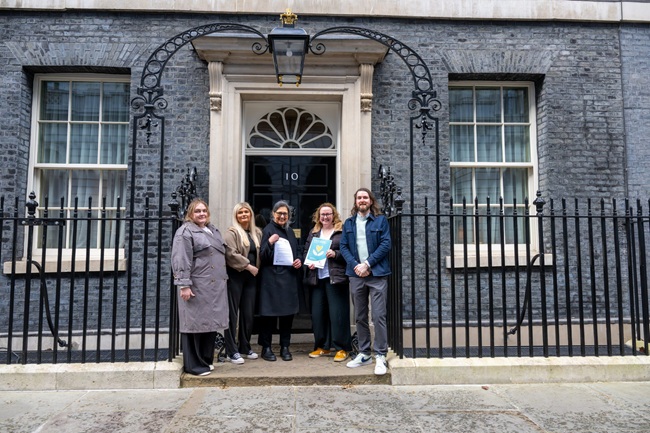
- Satwat Rehman, OPFS Chief Executive
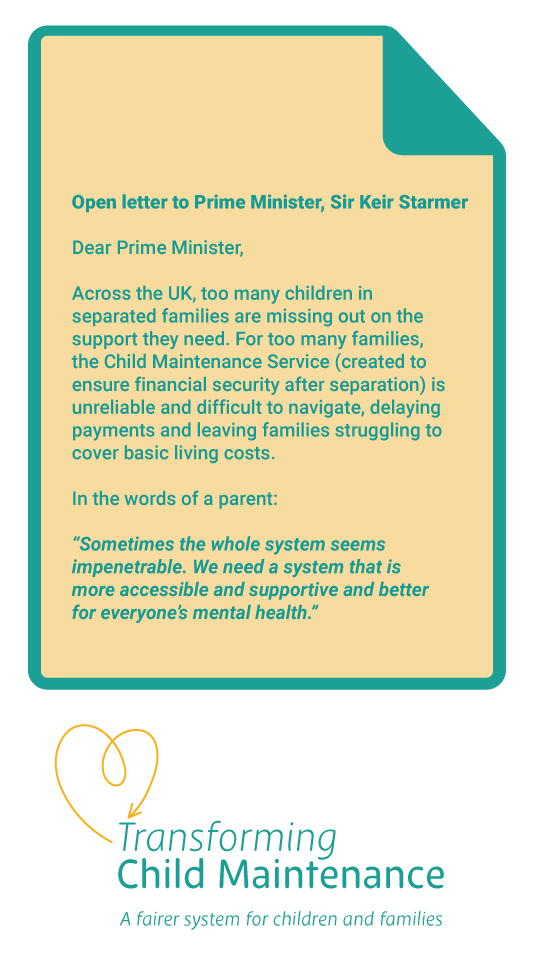
The letter sets out a clear plan to transform child maintenance, based on 14 recommendations, detailed in ‘Better for everyone: a new vision for child maintenance’. These were co-produced with single parents as part of the Transforming Child Maintenance project, led by OPFS in partnership with the Institute of Public Policy Research (IPPR) Scotland and Fife Gingerbread. The recommendations call on the UK Government to:
- Transform the CMS by introducing a universal payment platform for all families and the removal of fees, so it works as a first resort, not a last.
- Provide support outside the CMS so that parents can get the right help at the right time.
- Ensure that the child maintenance formula is fair and up to date, reflecting real living costs.
- Make the social security system work better for separated families, recognising that child maintenance is not the only anti-poverty tool.
Single parents and anti-poverty campaigners have hand-delivered an open letter to the Prime Minister in Downing Street. They are calling for urgent action to transform the Child Maintenance Service (CMS), outlining recommendations that could lift 210,000 children out of poverty across the UK.
The letter gained strong support, securing over 1,200 signatures from individuals across the UK. It is signed by Satwat Rehman, Chief Executive of One Parent Families Scotland (OPFS), and supported by 23 UK charities, including Save the Children, Gingerbread, The Good Law Project and Scottish Women’s Aid.
Satwat Rehman, Chief Executive of OPFS, said:
“Navigating the Child Maintenance Service can feel like playing an impossible game of Snakes and Ladders. Just when parents feel they are making progress, they are forced backwards, often having to re-tell traumatic experiences to different call-handlers. It can feel like they are caught up in a never-ending loop where they will never move forward. For too many, the process becomes so difficult, they give up altogether.
“Across the UK, over a million separated families have no child maintenance arrangement. This means children are missing out on money that should be helping to keep them warm, fed and able to thrive.
“We need a system that works for families, but right now they are being let down by one that simply isn’t fit for purpose. We know that over 200,000 children across the UK could be lifted out of poverty if they were able to access the money owed to them through child maintenance.
“Children cannot wait – the UK Government needs to act now.”
- Katarzyna, Member of the Single Parent Expert Group on child maintenance
Single parent, Katarzyna, travelled with OPFS and her seven-year-old daughter from Glasgow to London to deliver the letter. She said:
“I was part of the group of single parents that helped shape these recommendations. What came through really clearly in the group is that the Child Maintenance Service isn’t working for either paying or receiving parents.
“They need to do more to protect parents who are victim-survivors of domestic abuse and close loopholes that allow people to avoid paying maintenance for their children. The recommendations in the report would make a real difference to all separated families. Things like better enforcement, trauma informed training for call handlers, having a named caseworker and updating the calculation formula so it reflects real living costs.
“I work full time and always put the needs of my daughter first. But I am constantly juggling finances because I can’t rely on child maintenance coming through. This is not how it’s meant to work. Children should not be left without the support they are entitled to, and parents should not have to navigate stress to secure it.”
We now await a response from the Prime Minister and will continue to push for action so that children receive the financial support they are entitled to.