UK Government response to Public Services Committee CMS report
In January 2025, the UK Government published its response to an enquiry undertaken by the House of Lords Public Service Committee on reforming the child maintenance system. This response details the UK Government’s intentions on how to proceed with the Committee’s recommendations – including whether they will take action as a result.
06/02/2026
News
- Satwat Rehman, OPFS Chief Executive
Background
Over the last two and a half years, in partnership with Fife Gingerbread and IPPR Scotland, One Parent Families Scotland (OPFS) has worked alongside single parent families to design a new vision for the child maintenance system. Some of the outcomes from our Transforming Child Maintenance project are reflected within both the Committee and the UK Government’s responses.
What the House of Lords Committee said
OPFS is broadly supportive of the Committee’s report. It is encouraging that the recommendations, developed independently from our own, reflected many of the same challenges within the system that parents shared with us.
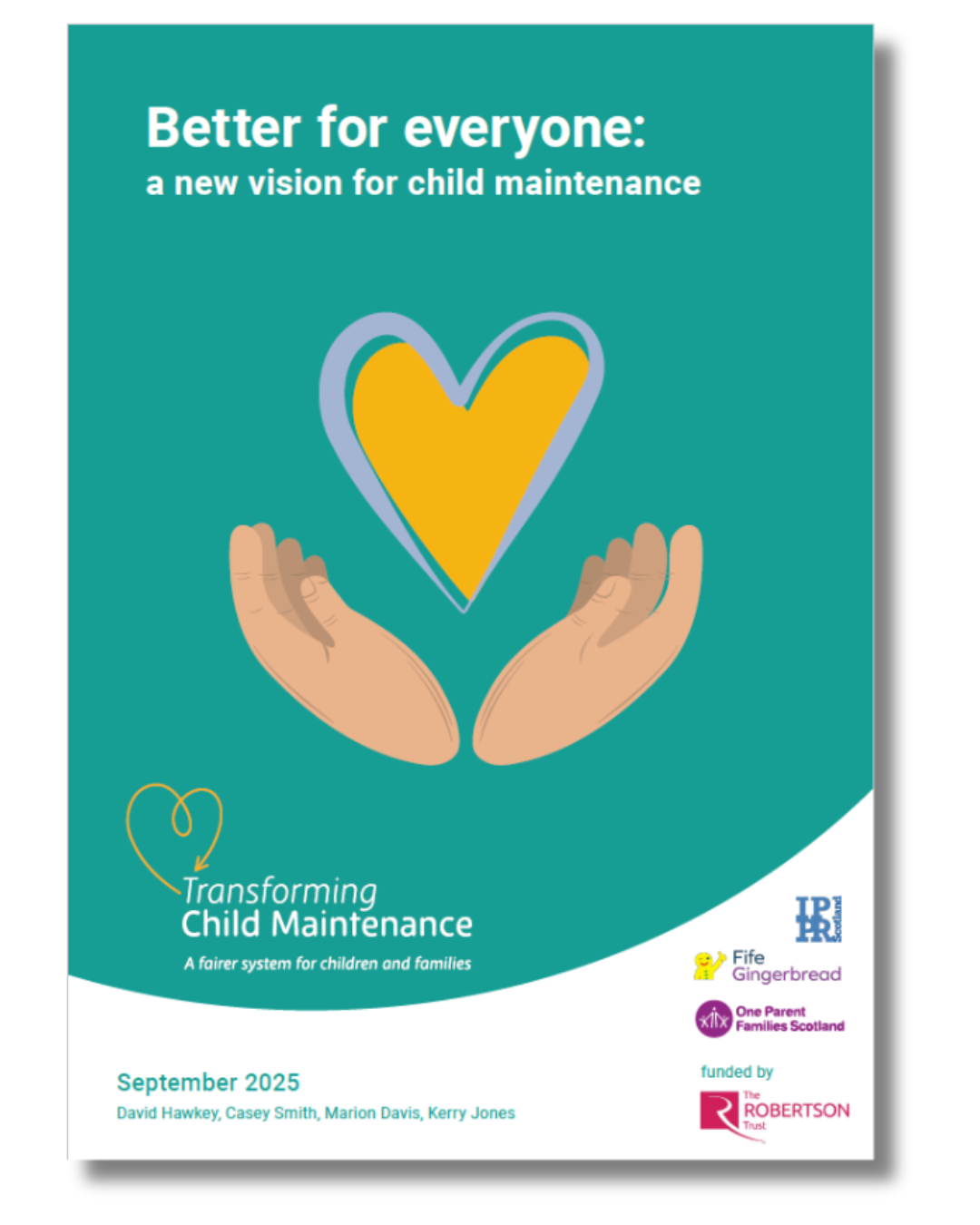
The House of Lords enquiry raised several important aspects of the child maintenance system in need of reform, many of which were aligned with calls contained within our Transforming Child Maintenance report ‘Better for everyone: A new vision for child maintenance’.
These include:
- improved support for victim-survivors of domestic abuse
- enhanced transparency surrounding the calculation used to determine payment amounts
- more consistent application of escalation processes for parents, and improved information sharing regarding these
The UK Government response
Areas of welcome progress
The UK Government’s response to the House of Lords enquiry contains several aspects that we are supportive of, including:
• enhanced trauma-informed practice within the child maintenance system
• named case workers for some complex cases (albeit this does not apply to all complex cases)
• acknowledgement of the system’s role in tackling child poverty
Concerns about Collect and Pay
The child maintenance system can and must go further to support children and families across the UK. At OPFS, we remain concerned about proposals to move all cases within the child maintenance system onto Collect and Pay.
This is despite broad acknowledgement that the introduction of fees would likely discourage parents from accessing the system as such fees did not apply under Direct Pay. While fees would be reduced to 2% (from 4%), for parents that have not previously been required to pay to access the system, this could still act as a deterrent.
We know from our work through Transforming Child Maintenance that the current system encourages parents to make Family Based Arrangements for child maintenance where possible. However, in practice this results in many families having no active arrangement at all.
The recommendations within ‘Better for everyone: A new vision for child maintenance’ include an alternative proposal to create a child maintenance payment platform that is open to all separated families from the start. This would replace Direct Pay and Collect and Pay. A universal payment platform would allow for monitoring of payments, including where the amounts that parents choose to pay are higher than statutory requirements. It would also reduce the level of conflict and stigma associated with the child maintenance system overall by making it more inclusive. We need a child maintenance system that welcomes families in rather than pushing them away.
Affordability and income variation
At present the system requires paying parents to have an income variation of +/- 25% prior to maintenance obligations being recalculated. The UK Government’s position in its response is that this prevents unnecessary changes to maintenance amounts based on small income variations. However, parents have told us that the requirement for such significant variation before recalculation can have a negative impact on the affordability of their obligations.
Domestic abuse protections and implementation
Finally, we are eager to see the Child Support Collection (Domestic Abuse) Act implemented at the earliest opportunity. Within its response, the UK Government highlights a desire to introduce new legislation in lieu of this, despite it already receiving Royal Assent in 2023. However, this new legislation is not due to be introduced for a significant period of time. It is essential that sufficient supports are in place for victim-survivors of domestic abuse prior to this – including powers within the Act that would allow the opportunity to move directly to Collect and Pay upon entering the system.